
Read the Operating Statement and NOI
Commercial real estate financing starts with the property’s ability to generate sustainable operating income. Gross potential rent assumes space is rented under the stated terms. Effective income reflects vacancy, concessions, credit loss and other eligible income. Net operating income then subtracts operating expenses such as taxes, insurance, management, repairs and owner-paid utilities.
NOI is not cash after mortgage payments. Debt service is considered separately, as are investor taxes and many capital expenditures. A lender may use an adjusted net cash flow that also deducts replacement reserves or other allowances. Confirm the definition rather than treating NOI and underwritten net cash flow as interchangeable.
Reconcile historical statements with leases, a rent roll and the proposed operating plan. A one-time expense should not be removed without explanation, and a temporarily low management charge may not represent market operating cost. Evaluate whether taxes will change after purchase, insurance quotes reflect the actual use and maintenance has been deferred. Underwriting may normalize expenses or income rather than simply accepting the seller’s figures. Build both historical and stabilized views with labeled assumptions. A compelling pro forma is useful only when the path to achieving it is credible and adequately funded during the transition.
Worked example
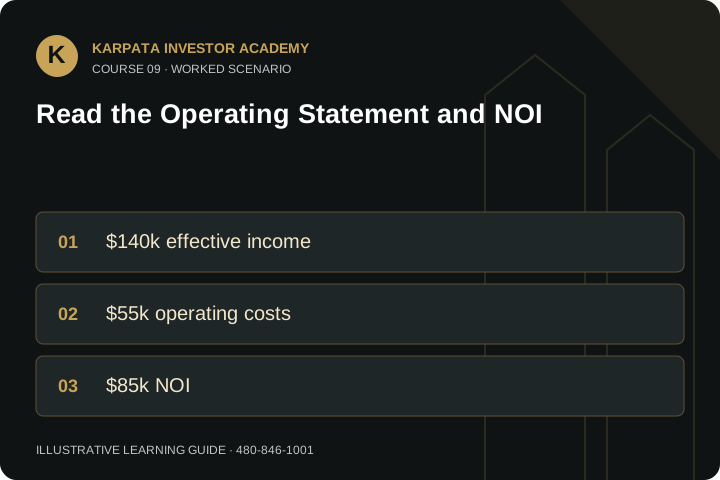
Annual potential rent is $150,000. Vacancy and credit loss are $10,000, leaving $140,000 effective income. Operating expenses of $55,000 produce $85,000 NOI. With $60,000 annual debt service, cash before capital work and investor tax is $25,000, assuming no other adjustments.
Mini glossary
- Effective income
- Income after vacancy, concessions and collection loss.
- NOI
- Operating income after operating expenses, before debt service.
- Pro forma
- Forecast financial statement with stated assumptions.
Put it into practice
Build an annual operating statement from a sample rent roll. Separate operating expenses, debt service and capital improvements. Compare seller figures with current tax and insurance evidence. Label every stabilization assumption and ask which adjustments the lender makes to reach its underwritten income figure.
Recommended reading
Use these primary sources for context. Individual lender requirements can change; confirm the current program for your transaction.