
Budget Profit Before Borrowing
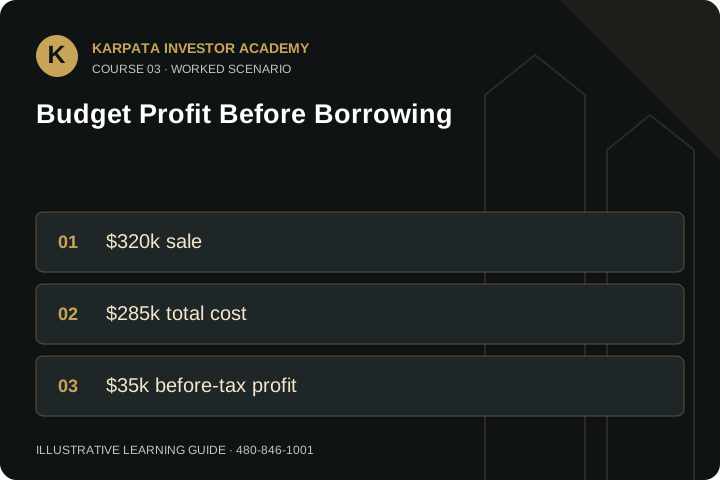
Flip profit is sale proceeds minus the complete economic cost of the project. Start with purchase price and a detailed renovation scope, then add acquisition costs, permits, utilities, insurance, property taxes, financing charges, carrying expenses and selling costs. A favorable purchase-to-sale spread is not a reliable profit estimate until all these items are included.
Create a contingency based on the building’s condition and the certainty of the scope. Older systems, concealed damage and structural alterations warrant careful investigation. Keep contingency separate from the planned scope so a change order does not disappear inside a vague budget. A lender’s approved budget and your total economic budget may have different definitions.
Timing affects every monthly carrying cost. Estimate a realistic construction period, marketing period and closing period, then test a delay. Separate cash expenses from loan principal: the principal funded the purchase or renovation already counted in the budget, so subtracting the full payoff again from economic profit would double-count that funded cost. A closing cash waterfall, in contrast, subtracts payoff from sale proceeds to show cash distributed. Keep those two views distinct and reconcile them before deciding whether the expected reward compensates for the risk.
Worked example
Sale price is $320,000. Purchase $200,000, renovation $50,000, finance/carry $15,000 and selling/closing costs $20,000 leave $35,000 before tax. A $10,000 overrun and $5,000 delay cost reduce that to $20,000. The initial $120,000 purchase-to-sale spread overstated expected profit.
Mini glossary
- Contingency
- Budget allowance for unexpected project costs.
- Carrying cost
- Ongoing expenses while holding the property.
- Cash waterfall
- Ordered distribution of closing proceeds and payoffs.
Put it into practice
Build an economic profit budget and a separate sale closing waterfall. Add a delay and lower sale price. Mark which costs depend on time and which depend on sale value. Obtain contractor bids for the largest uncertain items before treating the modeled profit as dependable.
Recommended reading
Use these primary sources for context. Individual lender requirements can change; confirm the current program for your transaction.