
Prepare Your Borrower Profile
Before shopping for an investment property, understand your borrowing position. Review credit reports for accuracy, identify existing debts and document available funds. A lender may evaluate credit, liquidity, background, experience and financial obligations even when the product emphasizes property income. No personal-income documentation is not the same as no borrower review.
Separate available money from money committed elsewhere. Your down payment, closing charges, required reserves and property operating cushion have different jobs. Identify the source of each contribution and keep records supporting transfers. Borrowed funds, gifts and partner equity can have program-specific eligibility and documentation rules; disclose them rather than assuming they are interchangeable.
Entity ownership is also a financing decision. Some business-purpose products allow or require an entity, while others use individual borrowers. An LLC does not automatically remove personal guarantees or solve liability, tax and insurance issues. Coordinate the proposed ownership with lender, legal and tax advisers before signing or transferring title. Be honest about your investment experience and use qualified property professionals where needed. A first-time investor can improve readiness with a clear plan and organized records; overstating experience or hiding obligations creates avoidable underwriting problems and can jeopardize closing.
Worked example
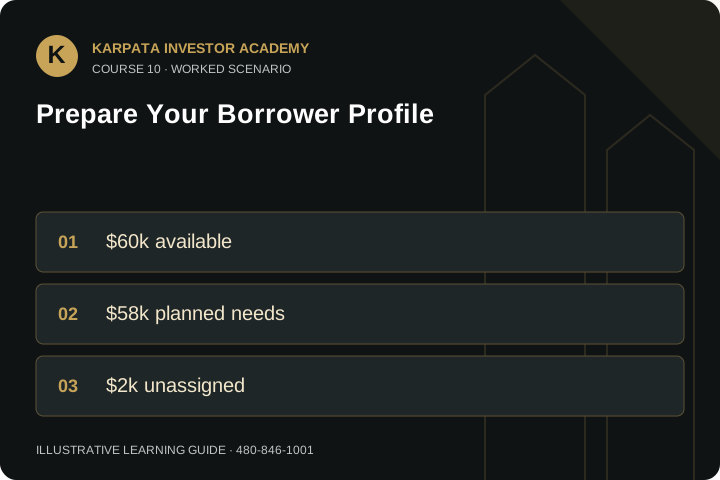
Available cash is $60,000. Planned down payment is $40,000, closing charges $8,000 and required post-closing reserves $10,000, leaving $2,000 unassigned. If another $7,000 is needed for initial repairs, there is a $5,000 shortage unless costs, financing or committed sources change.
Mini glossary
- Liquidity
- Cash or accessible funds for obligations.
- Guarantor
- Party accepting specified repayment or other liability.
- Entity
- Legal ownership structure such as an LLC.
Put it into practice
Prepare a borrower summary with credit range, debts, available funds and experience. Reconcile cash to down payment, fees, repairs and reserves. Ask about permitted ownership and guarantee requirements before setting up an entity for this transaction. Keep sensitive documents in the lender’s approved secure channel.
Recommended reading
Use these primary sources for context. Individual lender requirements can change; confirm the current program for your transaction.